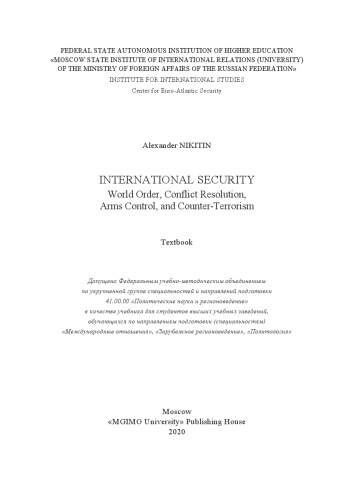
International Security:
-
 Writen byNikitin A.
 - PublisherMGIMO University, Ministry of Foreign Affairs of the Russian Federation)
- Year2020
This book provides a structured and academically grounded exploration of major pillars of international security, including world order dynamics, mechanisms of conflict resolution, the evolution of arms control regimes, and contemporary counter-terrorism frameworks. Integrating theoretical foundations with state-centric strategic assessments, Nikitin examines how geopolitical competition, institutional cooperation, and technological transformations impact global stability. The text benefits from MGIMO’s tradition of blending diplomatic analysis with practical security policy, offering insights into both historical and modern patterns of conflict and cooperation. Its relevance to the current era is substantial, as increasing multipolarity, weakening arms-control agreements, cyber and hybrid threats, and transnational terrorism challenge the foundations of the international security architecture; thus the book serves as a timely reference for understanding the shifting global power balance, renewed great-power rivalries, and the urgent need for effective multilateral conflict-management mechanisms.The book’s strengths lie in its comprehensive scope across major security pillars, its structured treatment suitable for academic and practitioner audiences, and its grounding in an institution with deep expertise in diplomacy and global security. It offers balanced theoretical discussions alongside pragmatic policy considerations. However, its perspective may be influenced by Russian strategic and diplomatic framing, potentially limiting the plurality of viewpoints typical in Western scholarship. The lack of detailed empirical case studies may reduce its applicability for advanced comparative research, and the absence of transparent methodological tools may constrain its utility for data-driven analysis. Despite these limitations, it remains a valuable conceptual and policy-oriented resource.A solid and informative contribution to international security literature, particularly strong for readers seeking conceptual foundations and state-centric analytical perspectives. While some geopolitical framing may reflect Russian strategic orientations, the book remains useful for understanding global security debates and is suitable for inclusion in a security studies repository, especially for comparative and diplomatic-security scholarship.