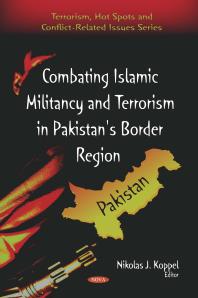
Combating Islamic Militancy and Terrorism in Pakistan's Border Region
-
 Writen byNikolas J. Koppel
 - PublisherNova Science Publishers, Incorporated
- Year2010
The book provides a detailed examination of growing militant activity in western Pakistan—particularly the Federally Administered Tribal Areas (FATA) and Khyber Pakhtunkhwa—and explains how the rise of Islamist militant groups, cross-border insurgency, and expanding Talibanization have shaped the broader regional security landscape. It analyzes Pakistan’s strategic dilemmas, U.S.–Pakistan relations after 9/11, the operational complexity of counterterrorism cooperation, and the persistent doubts regarding Islamabad’s commitment to U.S. objectives in Afghanistan. Highlighting key national security threats—including potential attacks against the U.S., risks to Pakistan’s political stability, and obstacles to U.S. stabilization efforts in Afghanistan—the book underscores the enduring geopolitical tensions that have defined the post-2001 security environment. Its relevance remains strong today, as militant regrouping, border-area radicalization, and evolving Pakistan–Afghanistan relations continue to influence contemporary terrorism dynamics, the politics of safe havens, and international counter-extremism strategies.The book provides a comprehensive aggregation of U.S. government assessments, intelligence-derived reports, and policy documents, making it a valuable reference for understanding U.S. perspectives on militancy in Pakistan’s border region. Its strengths include clear structuring, policy-focused analysis, and effective synthesis of complex security material. However, because it is an edited and excerpted compilation of government publications, it lacks original academic theorization, independent field research, and local Pakistani perspectives—limiting its analytical balance. Its framing is heavily U.S.-centric and occasionally overlooks socio-political drivers such as local tribal governance, economic marginalization, civilian casualties, and internal provincial politics. Although dated (pre-2010), many foundational issues—militant networks, border governance failures, U.S.–Pakistan mistrust dynamics—remain relevant. Still, it does not cover later developments such as TTP resurgence post-2014, Pakistan’s National Action Plan, ISKP expansion, or post-Taliban-takeover (2021) regional shifts.A strong policy-oriented overview of militant dynamics in western Pakistan that effectively captures the U.S. strategic viewpoint and early War-on-Terror-era security concerns. While limited by lack of local nuance and later developments, it remains an important document for historical context and policymaking insight.