
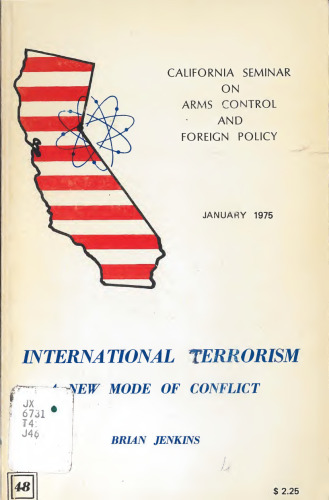
International Terrorism:
-
 Writen byBrian Michael Jenkins
 - PublisherCrescent Publications
- Year1975
This early foundational work by Brian Michael Jenkins examines the rise of international terrorism as an emerging form of political conflict within the Cold War era, arguing that terrorism represents a new mode of confrontation in which non-state groups leverage publicity, fear, and symbolic violence rather than conventional military power. Jenkins analyzes the motives, strategies, and operational patterns of terrorist organizations of the 1960s–1970s, offering one of the earliest systematic frameworks for understanding transnational terrorism, hostage-taking, hijackings, and political propaganda through violence. Despite being written in 1975, the monograph remains historically relevant because Jenkins’ insights—particularly his observation that “terrorism is theater”—continue to shape contemporary academic and policy discourse on asymmetric conflict, media amplification, radicalization, and states’ responses. While dated in empirical scope, it is invaluable for understanding the evolution of terrorism research and the conceptual roots of modern counterterrorism thinking.Jenkins’ contribution stands out for its pioneering conceptual clarity, distilling terrorism into strategic communication rather than raw violence. The monograph anticipated many dynamics later seen in Middle Eastern, European, and global terrorism movements. Its main limitation is age: the work predates modern developments such as religious extremism, digital radicalization, global jihadist networks, and cyber-based terrorism. The empirical examples are restricted to 1970s groups, and the analysis lacks contemporary methodological rigor. Nonetheless, as a formative text, it serves as an essential reference point for students and scholars tracing the intellectual genealogy of terrorism studies.A historically significant and conceptually sharp early study of international terrorism, foundational for understanding how scholars and policymakers first conceptualized terrorism as a strategic and communicative form of conflict. Highly valuable for archives, research collections, and comparative terrorism studies.