
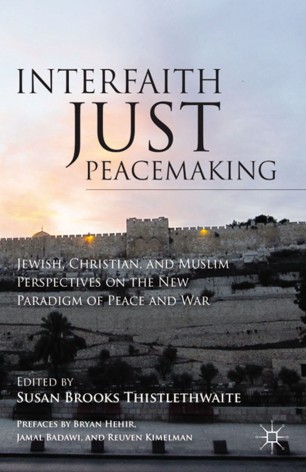
Interfaith Just Peacemaking:
-
 Writen bySusan Brooks Thistlethwaite (ed.)
 - PublisherPalgrave Macmillan (Springer Science+Business Media LLC)
- Year2012
This volume expands on the Just Peacemaking paradigm, originally rooted in Christian ethics, by integrating Jewish, Christian, and Muslim perspectives to develop a shared interfaith framework for peace and nonviolent conflict transformation. Key aspects include: Reinterpretation of Just War theory through interreligious dialogue — moving from “justified violence” toward “preventive and restorative peace.” Essays from Jewish, Muslim, and Christian scholars who apply scriptural, ethical, and theological reasoning to contemporary challenges of war, terrorism, and reconciliation. Topics addressed include: Theological bases for nonviolence and reconciliation. Religious contributions to human rights, social justice, and restorative practices. Peacemaking in response to modern conflicts — from inter-communal violence to state warfare. A shared moral and spiritual language is developed for interfaith cooperation on peace initiatives.Contemporary significance: The Just Peacemaking framework is increasingly applied in faith-based diplomacy, restorative justice, and interreligious peace processes (e.g., Israel–Palestine, interfaith humanitarian coalitions). The text provides a model for religious cooperation in public policy, emphasizing how theological ethics can shape practical peacebuilding. Academic use: Frequently included in syllabi on religion and conflict resolution or theological ethics. Valuable for comparative studies examining the moral foundations of peace across Abrahamic traditions. Practical relevance: Offers theological and moral grounding for faith-based NGOs, interfaith networks, and peace institutes. Encourages religious literacy in policy design around coexistence, deradicalization, and social reconciliation.A seminal interfaith volume that extends Just Peacemaking into a multi-religious dialogue framework. It stands out for its moral clarity, scholarly depth, and enduring relevance in promoting faith-based peacebuilding initiatives.