
Building Peace in Permanent War:
-
 Writen byBen Hayes; Gavin Sullivan; Louise Boon‑Kuo; Vicki Sentas
 - PublisherTransnational Institute / International State Crime Initiative (co‑published)
- YearFebruary 2015
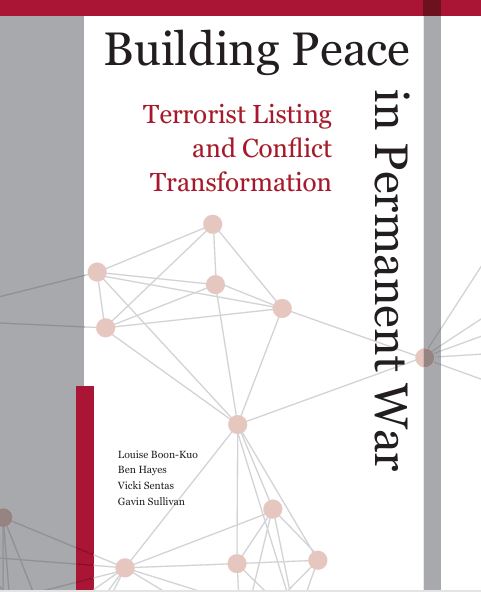
The report examines how the proliferation of terrorist‑listing regimes and broad counter‑terrorism laws affect peacebuilding and conflict‑transformation efforts in contexts of ongoing armed conflicts. It explores the way in which non‑state armed groups designated as “terrorists” (for example, Al‑Shabaab in Somalia, Hamas in the Occupied Palestinian Territories, the Kurdistan Workers’ Party in Turkey) become difficult or impossible to engage with by mediation and peace actors because of legal and reputational risks. The authors argue that rather than being unintended side‑effects, the shrinking space for peacebuilding may be a foreseeable result of how counter‑terror laws are structured. The report uses qualitative case studies, interviews, and legal/policy analysis to show that “permanent war” logic—enabled by sanctioning and proscription—undermines inclusive conflict transformation. In a world where the war on terror has extended into multiple theatres and where NGOs, peacebuilders, and mediators operate amid dominant security frameworks, this report’s relevance is significant. It highlights how counter‑terrorism legal frameworks can inadvertently hamper community‑based dialogue, rehabilitation initiatives, and inclusive peace processes. For community engagement, it suggests the need for legal awareness among civil society actors, the design of programmes that account for proscription risks, and the strategic involvement of third‑parties to navigate legal and security constraints. It offers a foundation for education modules on how security, law, and civil society interact in conflict settings, and for developing operational protocols for NGOs engaged in dialogue with non‑state armed groups under counter‑terror regimes.This report is a timely and important contribution to understanding the intersection of counter‑terrorism law and peacebuilding. It opens critical space for reflection on how the design of legal sanctions and listings may hinder not only armed adversaries but also the very actors committed to resolving conflict. It is a valuable resource for researchers, policymakers, practitioners in peace and security, and civil society organisations seeking to engage in conflict transformation in security‑driven contexts.