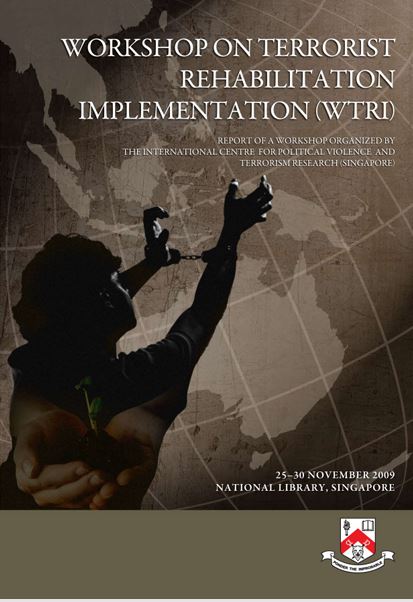
Workshop on Terrorist Rehabilitation Implementation (WTRI)
-
 Writen byOrganized by: International Centre for Political Violence and Terrorism Research (ICPVTR) S. Rajaratnam School of International Studies (RSIS), Nanyang Technological University, Singapore
 - PublisherICPVTR – S. Rajaratnam School of International Studies (RSIS), Nanyang Technological University, Singapore
- Year2010
The Workshop on Terrorist Rehabilitation Implementation (WTRI), organized by the International Centre for Political Violence and Terrorism Research (ICPVTR) at RSIS, Nanyang Technological University, served as a high-level training and policy dialogue platform focusing on the practical frameworks, methodologies, and challenges of implementing terrorist rehabilitation programs across different nations. The workshop brought together government officials, psychologists, scholars, and correctional officers from multiple countries to examine diverse rehabilitation experiences and strategies. Sessions highlighted comparative models from Singapore, Saudi Arabia, Iraq, Yemen, and the Philippines, emphasizing localized adaptations of faith-based and psychological rehabilitation. Topics included ideological counter-narratives, humane treatment of detainees, psychological rehabilitation, creative arts therapy, and curbing online radicalization. Unique contributions, such as music therapy as a rehabilitation tool and creative arts as psychological intervention, were explored as alternative means for transformation and reintegration. By combining security, psychology, and faith-based approaches, the workshop advanced a holistic understanding of rehabilitation as both a counterterrorism and social reintegration strategy.The WTRI proceedings provide one of the earliest comprehensive frameworks for implementing terrorist rehabilitation programs within the Asia-Pacific context. Its inclusion of psychological, ideological, and creative approaches marks it as a pioneering work that continues to influence modern rehabilitation models globally. The report’s multidisciplinary scope—spanning security, religion, psychology, and the arts—makes it particularly valuable for researchers and practitioners working on community-based rehabilitation and counter-extremism initiatives.