
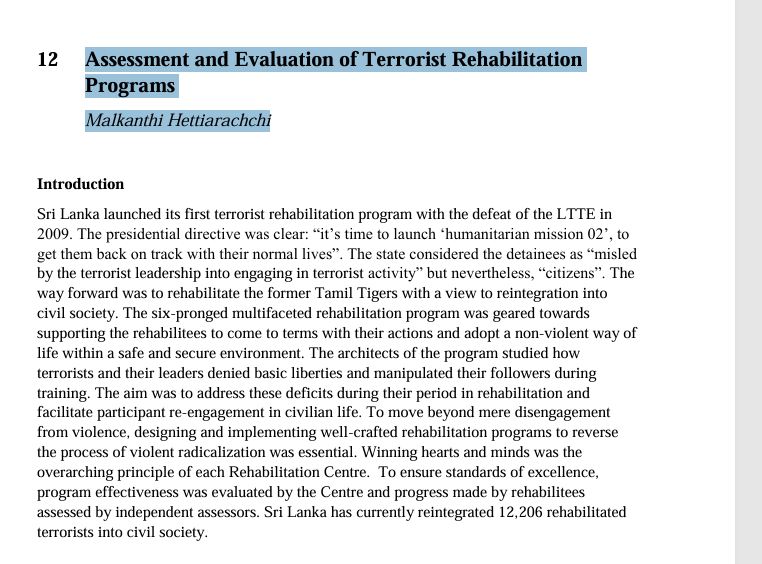
Assessment and Evaluation of Terrorist Rehabilitation Programmes
-
 Writen byMalkanthi Hettiarachchi
 - PublisherRoutledge / RSIS Publications (Gunaratna’s edited volume)
- Year2018 (part of the vo
In “Assessment and Evaluation of Terrorist Rehabilitation Programmes”, Malkanthi Hettiarachchi examines how terrorist rehabilitation programs are assessed and evaluated globally, with detailed reference to Sri Lanka’s program among others. The chapter surveys tools currently in use—such as VERA-2R, the Violent Extremist Belief Scale, Extremist Risk Guidelines, and others—to assess levels of radicalization and measure shifts in beliefs, attitudes, and behaviour. Hettiarachchi highlights challenges in assessment: how to measure ideological change, how to distinguish superficial compliance from genuine transformation, how to maintain post-rehabilitation progress, and how to engage communities to sustain reintegration. The author argues that both simple and complex measurement tools must be adapted to context and that rigorous evaluation is crucial not only to validate the programs but also to inform continuous improvement and resource allocation.Given rising global concern over extremist ideologies and the need for effective counter-narratives, this chapter is extremely relevant. It helps practitioners, policymakers, and program designers understand how to measure what works in rehabilitation. Community engagement mechanisms include: Training program designers and staff in designing evaluation metrics that capture both attitudes and behaviour change. Engaging local communities in defining what successful reintegration looks like. Using independent evaluation results for transparency and accountability with stakeholders. Incorporating assessment methods into rehabilitation programs to track progress and adapt strategies. This chapter offers critical methodological guidance for anyone involved in counterterrorism rehabilitation. It's a key contribution to the field, particularly for its practical insights into assessment tools and its balanced critique of their limitations.