

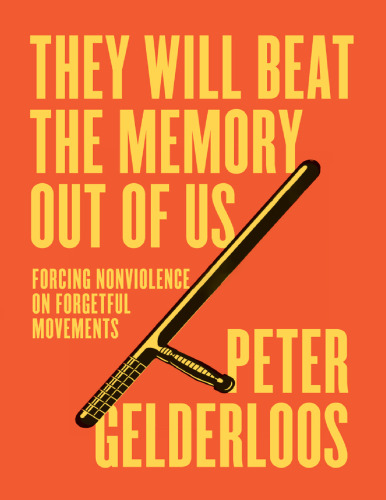
They Will Beat the Memory Out of Us:
-
 Writen byPeter Gelderloos
 - PublisherPluto Press, London ; also listed with Las Vegas, NV
- Year2024
They Will Beat the Memory Out of Us offers a radical critique of how nonviolent movements often fail not because nonviolence is always wrong, but because movements forget. Gelderloos argues that many nonviolent campaigns suffer from social amnesia—a loss or distortion of historical and intergenerational memory of resistance struggles. He examines cases such as antiracist rebellions following police murders (e.g. in Minneapolis), climate movements that ignore colonial histories, and other moments of activism where the past is eclipsed or misremembered. Through history, personal reflections, interviews, and vignettes, he traces how forgetting weakens movements, opens them up to cooptation, diminishes their radical potential, and aligns them more with pacification than transformative justice. The book warns against “forcing nonviolence” in contexts where memory is stifled, and calls for collective memory practices, attention to roots, and methods for remembering and inheriting lessons from past struggles as part of sustaining resistance.The book is very relevant now, given global struggles over police violence, systemic racism, climate crisis, colonial legacies, and efforts to sanitize or neutralize social movements through institutional channels. With movements succeeding or failing in part because of how memory is handled—what histories are taught, what stories are preserved, which heroes are remembered—Gelderloos’s critique gives insight into current challenges: misrepresentation, erasure, superficial reform rather than radical change. In practical terms, this book can inform movement strategy, activist education, curriculum design, and memorialization efforts. It motivates activists to include memory work (archives, oral histories, commemoration), intergenerational dialogue, resistance to coopted narratives, and critical reflection on how movement histories are passed or lost. Community engagement could include organizing memory-sharing sessions among activists; workshops for youth in activist organizations about past movements; creating public memorials, exhibitions, or digital archives of resistance histories; partnering with schools or community centers to integrate neglected histories; and dialogues between older and younger activists to transmit lessons.They Will Beat the Memory Out of Us is a potent and necessary intervention. It addresses a gap in the nonviolence literature: not just whether nonviolence works, but what happens when movements forget. This book’s insistence on memory as a component of resistance adds depth to debates about strategy, movement sustainability, and justice. It is a valuable contribution to movement theory, activism, and memory studies. Strengths: The book’s strength lies in its originality: focusing on memory as a decisive factor in the effectiveness and integrity of nonviolent movements. Its use of concrete vignettes, personal interviews, and reflections gives both theoretical heft and grounded feeling. It clearly links forgetting to cooptation, loss of radical edge, and erosion of movement legitimacy. It raises questions not often foregrounded: which narratives are preserved, which are erased, who controls the memory, what intergenerational transmission looks like. Weaknesses: Because the book is relatively short (~170 pages), some cases are necessarily less detailed; there may be uneven depth in comparative analysis. Gelderloos is known for strong critiques of nonviolence from a radical/anarchist perspective; readers seeking a balanced or mixed approach might find his framing skewed or one-sided. Also, while he calls for memory work, practical guidance on how to institutionalize these practices in diverse cultural contexts may be less detailed.