
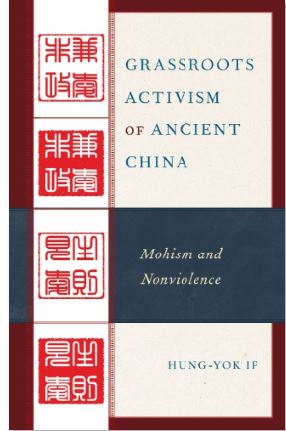
Grassroots Activism of Ancient China:
-
 Writen byHung-yok Ip
 - PublisherLexington Books / Rowman & Littlefield (Lanham) (imprint
- Year2022
In Grassroots Activism of Ancient China: Mohism and Nonviolence, Hung-yok Ip examines the ancient Chinese school of Mohism—traditionally known for its philosophy of “impartial caring” and critique of ritual elitism—as a movement with activist impulses. Ip reconstructs how the Mohists saw themselves not merely as moral philosophers, but as grassroots actors striving to influence and transform society. The book shows that while the Mohists used persuasion, negotiation, and moral argumentation in confronting violence and inequality, they also did not entirely reject counterviolence (military or defensive action) when dealing with rulers who aggressed. The argument is that the Mohist movement cultivated a strategic knowledge (on tactics, persuasion, structure) and a notion of personhood and self-cultivation that made activism durable. Ip situates Mohism within the broader history of nonviolent activism, showing the tensions between moral persuasion and coercive response, and how ancient actors grappled with the limits of idealism in face of rulers’ aggression. Across chapters on sources, the milieu, the use of nonviolence, fighting violence, and epilogue reflections, the book weaves intellectual history, textual exegesis, and movement theory to show how Mohism’s activists attempted to operate in bounded but creative ways. Although the historic setting is ancient, the book’s exploration of how a moral movement negotiates power, conflict, persuasion, and resistance remains relevant. In contemporary settings where activists must decide whether to resist, negotiate, or defend, Mohism’s balance (and its internal tensions) can offer analogies or provocations. It reminds modern movements that nonviolence is not automatically pure, but is shaped by context, strategic knowledge, and moral self-cultivation. Practically, the book can inform comparative dialogues in peace studies, enrich nonviolence training by bringing non-Western genealogies of activism, and broaden conceptual palettes for movement strategists. Community engagement could include “philosophy & activism” reading groups comparing Mohist strategy to modern nonviolent movements; workshops in nonviolence curricula that include ancient wisdom traditions; public lectures in contexts where Eastern philosophy and peace activism intersect; dialogues between scholars and practitioners about the ethics of resistance and the place of limited force in morally complex settings. Grassroots Activism of Ancient China: Mohism and Nonviolence is a valuable and original contribution, particularly in bringing a neglected intellectual tradition into conversation with contemporary nonviolence and activism. It offers new lenses for understanding how moral movements negotiate power and how nonviolence is contingent, embedded, and strategic.