
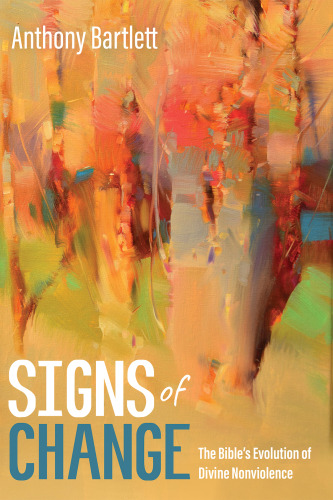
Signs of Change: The Bible’s Evolution of Divine Nonviolence
-
 Writen byAnthony Bartlett
 - PublisherWipf and Stock Publishers
- Year2022
Anthony Bartlett’s Signs of Change advances a theological and hermeneutical project: identifying the Bible’s trajectory as a movement from violent human interpretations of God to the revelation of a nonviolent, self-giving divine reality. Building upon his earlier work, Theology Beyond Metaphysics, Bartlett deploys the idea of semiotic change—a shift in the very signs and meanings by which people understand God and human relations. The book argues that the Bible should not be read as two oppositional Testaments (violent Old vs. peaceful New), but as an unfolding revelation where divine nonviolence gradually displaces violent theological constructs. Through detailed readings of Old Testament texts and the transformative witness of Jesus and Paul, Bartlett demonstrates how biblical narratives progressively unmask human violence and disclose God’s commitment to peace. This study situates biblical nonviolence not as an abstract theory but as a practical and theological imperative that can inspire contemporary Christian responses to conflict, war, and systemic violence. Bartlett’s book resonates strongly with GRACE’s mission by challenging violent theological justifications and uncovering the scriptural basis for peace and nonviolence. In contexts where sacred texts are misused to legitimize extremism or intolerance, Signs of Change equips readers with a hermeneutical framework to resist such distortions and promote dialogue.• University and seminary courses on biblical theology, ethics, and peace studies. • Interfaith workshops where scripture is studied for its nonviolent potential, fostering understanding across traditions. • Faith-based community reading groups using the book to counter extremist narratives. • Application in peacebuilding initiatives by Christian organizations seeking scriptural grounding for nonviolence. Signs of Change is a significant theological work that reframes biblical interpretation as a path toward divine nonviolence. It provides intellectual and spiritual resources for countering the misuse of scripture in violent ideologies while nurturing communities of peace. Evaluation of the Book Strengths: • Innovative use of semiotic theory to interpret biblical nonviolence. • Provides continuity between Old Testament and New Testament without dualistic opposition. • Theologically rich and practically relevant for contemporary peacebuilding. • Bridges academic theology with applied nonviolent ethics. Weaknesses / Limitations: • Its theoretical reliance on semiotics may be challenging for non-specialists. • The book focuses on Christian texts, limiting direct interfaith applicability (though the method can inspire cross-traditional dialogue). • Less practical guidance for grassroots activism compared to works on applied nonviolence.