

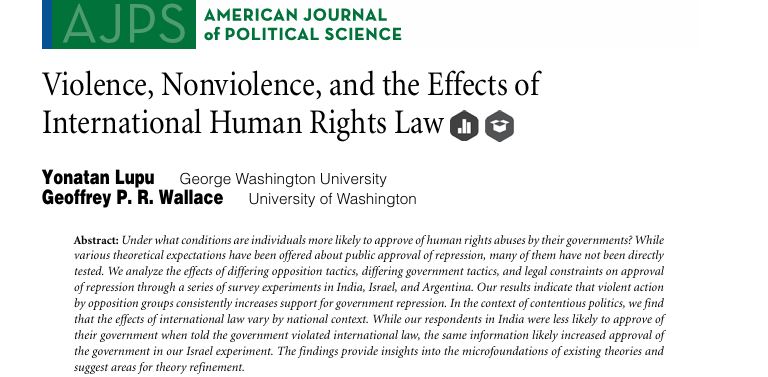
Violence, Nonviolence, and the Effects of International Human Rights Law
-
 Writen byYonatan Lupu; Geoffrey P. R. Wallace
 - PublisherWiley (Blackwell Publishing)
- Year2019
This article examines the relationship between international human rights law and the incidence of violence and nonviolence across states. Lupu and Wallace investigate whether human rights legal frameworks influence actors—states, insurgent groups, or civil society—to adopt nonviolent strategies over violent ones. The authors employ empirical analysis to assess how compliance with human rights treaties, monitoring mechanisms, and enforcement structures affects patterns of political violence. The study identifies conditions under which international norms encourage nonviolent behavior, including civil resistance, protest strategies, and institutional reforms. Conversely, it highlights circumstances where legal frameworks fail to prevent repression, demonstrating the limitations and potential of human rights law in fostering global peace. The article contributes to understanding the practical impact of international law on promoting nonviolence, offering insights relevant to policy makers, legal scholars, and civil society organizations engaged in human rights and peacebuilding initiatives. The research is highly relevant for academic, policy, and grassroots communities focused on human rights, conflict resolution, and nonviolent resistance. It can guide strategic interventions where international law can be leveraged to reduce violence and encourage nonviolent civic engagement. Community engagement mechanisms include: • Workshops for civil society organizations on legal frameworks supporting nonviolence. • Educational modules for university courses on international law and peace studies. • Policy briefings for governments and NGOs on treaty compliance and conflict mitigation. • Advocacy campaigns that link human rights law to nonviolent social change strategies. This article provides robust empirical evidence on the role of international human rights law in promoting nonviolence, making it a highly valuable resource for the GRACE repository, especially in linking law, policy, and peace studies. Strengths: • Empirical and data-driven analysis of human rights law’s effects on nonviolence. • Highlights practical mechanisms for encouraging nonviolent behavior globally. • Connects legal, political, and social dimensions of violence and peace. Limitations: • Highly technical; may require background in political science or law. • Focuses on state-level dynamics, less on grassroots nonviolent movements.


