
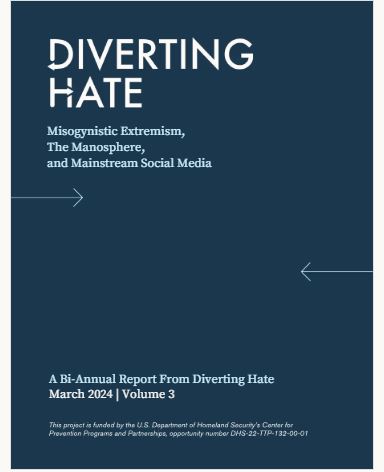
: Diverting Hate: Misogynistic Extremism, The Manosphere, and Mainstream Social Media (Bi-Annual Report, Volume 3)
-
 Writen byKaitlyn Tierney; Courtney Cano; Astrid Askenberger; Alana Olken; Clara Broekaert; Spencer Paik; Sean Kitson; Jill Jacobs; Eric Martinez
 - PublisherDiverting Hate (research initiative funded by the U.S. Department of Homeland Security’s Center for Prevention Programs and Partnerships)
- YearMarch 2024
This report, the third volume in the Diverting Hate series, examines how extremist misogyny within the manosphere has become normalized on mainstream social media platforms. It explores the spread of violent misogynistic ideology and harmful masculinity across platforms like YouTube and Gettr, and examines how such narratives influence younger generations, specifically Gen Z. The report uses YouTube case studies and content analysis to trace how misogynistic influencers reinforce gender stereotypes and contribute to offline violence. Importantly, it proposes empathy-driven digital interventions—like targeted ads—that redirect at-risk users toward supportive, prosocial communities. The report emphasizes the urgent need for collaborative stakeholder efforts, including platform moderation and advocacy, to mitigate the spread of misogynistic extremism online. • In an era of increasing online radicalization—not just along political but also gendered lines—this report is timely and critical. It foregrounds how misogynistic ideology online can escalate into real-world harm, especially against women. • Its proposed interventions—empathy-driven redirection, credible messaging, platform-level moderation—reflect innovative, community-focused strategies for prevention. • It serves as a model for multi-sector collaboration: tech, policy, mental health, and advocacy groups must work together to foster safer online environments• Strengths: High relevance, empirical data, clear call-to-action, innovative intervention strategies, multidisciplinary approach. • Weaknesses: Lacks formal ISBN and publisher branding, potentially limiting bibliographic traceability; being relatively short (~55 pages), it may not explore each issue in exhaustive depth. • Unique Contributions: Centers gendered extremism—often overlooked in mainstream radicalization discourse—and demonstrates empathy-based redirection as a viable platform intervention.