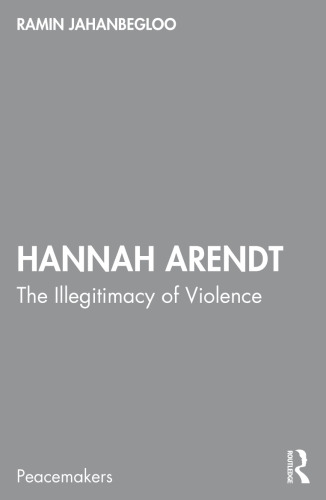
Hannah Arendt:
-
 Writen byRamin Jahanbegloo
 - Publisher Routledge India
- Year2025
This concise book offers a philosophical exploration of Hannah Arendt’s critique of violence, particularly in the wake of totalitarianism and modern political crises. Ramin Jahanbegloo skillfully engages Arendt’s political theories, especially her distinction between power and violence, while reinterpreting her thought through a comparative framework. Drawing on examples from India and Iran, the book contextualizes Arendt’s ideas within Eastern traditions of nonviolence, such as Gandhian ethics. It reveals the enduring relevance of Arendt’s political insights, especially her emphasis on dialogue, plurality, and the illegitimacy of violence in truly political action. This concise book offers a philosophical exploration of Hannah Arendt’s critique of violence, particularly in the wake of totalitarianism and modern political crises. Ramin Jahanbegloo skillfully engages Arendt’s political theories, especially her distinction between power and violence, while reinterpreting her thought through a comparative framework. Drawing on examples from India and Iran, the book contextualizes Arendt’s ideas within Eastern traditions of nonviolence, such as Gandhian ethics. It reveals the enduring relevance of Arendt’s political insights, especially her emphasis on dialogue, plurality, and the illegitimacy of violence in truly political action. This is an intellectually rich yet accessible resource that successfully bridges classical political thought with pressing contemporary issues. It is a significant contribution for those engaged in theoretical and practical aspects of nonviolence, offering both depth and real-world relevance. The book’s strengths include its interdisciplinary approach, concise format, and comparative analysis, especially its application of Arendtian theory to non-Western contexts. Its originality lies in interpreting Arendt’s work not just philosophically, but in dialogue with Gandhi’s legacy and the socio-political landscapes of Iran and India. A potential limitation is its brevity, which may limit deeper engagement with secondary debates on Arendt. Nonetheless, it stands out as a valuable educational and peacebuilding resource.