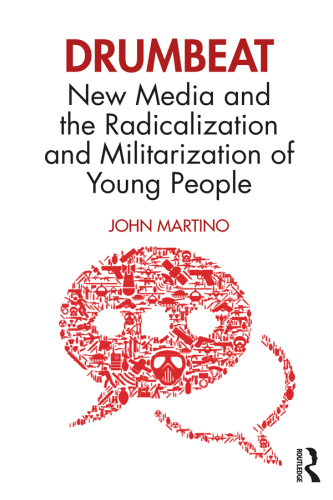
Drumbeat: New Media and the Radicalization and Militarization of Young People
-
 Writen byJohn Martino
 - PublisherTaylor & Francis
- Year2021
Drumbeat by John Martino investigates how young individuals are drawn into violent ideologies through the strategic use of new media. It discusses the dual processes of radicalization (primarily by non-state actors such as terrorist organizations) and militarization (carried out by state apparatuses) as public pedagogical tools that normalize war and violence. Martino draws on examples like the use of videogame aesthetics in jihadi propaganda, child soldier recruitment, martyrdom operations, and war glorification to argue that media serves not just as a communication platform but as an educative force shaping the worldview of youth. The book places these phenomena within the broader framework of public pedagogy and ideological conditioning, revealing how both state and non-state actors manipulate media environments to position societies especially young people for participation in conflict. Drumbeat by John Martino investigates how young individuals are drawn into violent ideologies through the strategic use of new media. It discusses the dual processes of radicalization (primarily by non-state actors such as terrorist organizations) and militarization (carried out by state apparatuses) as public pedagogical tools that normalize war and violence. Martino draws on examples like the use of videogame aesthetics in jihadi propaganda, child soldier recruitment, martyrdom operations, and war glorification to argue that media serves not just as a communication platform but as an educative force shaping the worldview of youth. The book places these phenomena within the broader framework of public pedagogy and ideological conditioning, revealing how both state and non-state actors manipulate media environments to position societies especially young people for participation in conflict. Drumbeat is a compelling and timely scholarly work that explores a complex intersection of technology, ideology, and youth manipulation. It offers both theoretical depth and practical implications, making it a valuable contribution to literature on radicalization and peace-building. Its exploration of media-driven violence and pedagogical resistance is particularly useful for institutions working on rehabilitation and community engagement.