
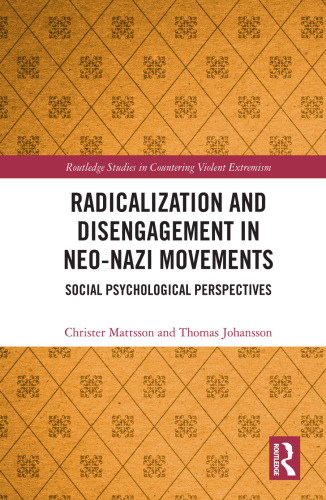
Radicalization and Disengagement in Neo-Nazi Movements:
-
 Writen by Christer Mattsson and Thomas Johansson
 - PublisherRoutledge
- Year2021
This book offers an in-depth study of personal accounts of individuals who have entered, participated in, and ultimately exited the neo-Nazi movement, focusing on advanced Western states. Through detailed narratives of the movement’s violence, hatred, and ideology, coupled with the individuals’ life plans and dreams when entering the movement and reintegrating into society, the work provides insights into the dynamics of radicalization and disengagement. The book presents innovative research on the relationship between the life trajectories of neo-Nazis and their significant others, enabling better strategies for preventing radicalization and promoting deradicalization. Extensive case studies include voices of those who returned to the movement or never left, offering a rare opportunity to compare active, former, and returned right-wing extremists. The authors employ social-psychological and sociological perspectives, emphasizing the importance of gender theory, sociocultural, historical, and contextual analyses to understand current trends within the neo-Nazi movement. In an era marked by the resurgence of far-right extremism, this publication provides critical insights into the processes of radicalization and disengagement within neo-Nazi movements. By understanding the personal narratives and social contexts that contribute to extremist involvement, policymakers, educators, and community leaders can develop targeted interventions to prevent radicalization and support disengagement. The book's emphasis on sociocultural and psychological factors aligns with contemporary strategies that prioritize community engagement, mental health support, and inclusive education to counteract extremist ideologies. Radicalization and Disengagement in Neo-Nazi Movements: Social Psychology Perspective" is a significant contribution to the field of extremism studies. Its comprehensive analysis of individual experiences within neo-Nazi movements, grounded in robust theoretical frameworks, offers valuable perspectives for academics, practitioners, and policymakers. The book's interdisciplinary approach enhances its applicability across various domains concerned with countering violent extremism.