
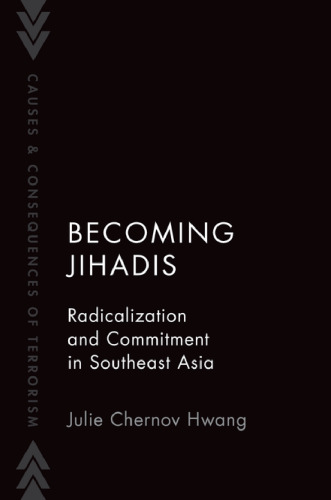
Becoming Jihadis: Radicalization and Commitment in Southeast Asia
-
 Writen byJulie Chernov Hwang
 - PublisherOxford University Press
- Year2023
Julie Chernov Hwang’s Becoming Jihadis explores the nuanced and deeply social process of radicalization in Southeast Asia, particularly in Indonesia and the Philippines. Drawing from 175 interviews over nearly a decade, the book challenges simplistic ideological explanations and instead emphasizes the pivotal role of personal relationships, emotional bonds, and communal belonging in facilitating extremist commitment. Through detailed life histories and fieldwork, it outlines how individuals build loyalty and identity within jihadist networks, including experiences in training camps, paramilitary operations, and collective actions. Ideology, while significant, is portrayed as a reinforcing mechanism rather than the primary driver. Relevance with the Current Era and Community Engagement Mechanism: With persistent threats from regional jihadist movements like Abu Sayyaf and Jemaah Islamiyah, this work is critically relevant. It offers grounded, actionable insight into the emotional and relational drivers of radicalization—essential for designing effective deradicalization and rehabilitation programs. The book can inform community-based strategies by highlighting the need for positive peer bonding, alternative networks of trust, and reintegration pathways that rebuild identity without extremism. It supports local NGOs, policymakers, and religious institutions in Southeast Asia and beyond. A methodologically sound and original work, Becoming Jihadis bridges the gap between academic theory and practical application. Its focus on socialization and emotional connection as key factors of radicalization represents a significant contribution to terrorism studies. It is indispensable for understanding the complex realities of extremist recruitment and commitment in non-Western contexts.