

India's Counter-Terrorism Diplomacy at the United Nations:
-
 Writen byVikash Chandra
 - PublisherIndia Quarterly: A Journal of International Affairs
- Year40-57
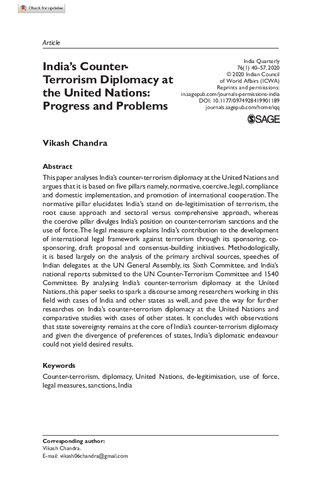
This article analyzes India's counter-terrorism diplomacy at the United Nations, focusing on five key pillars: normative measures, coercive strategies, legal frameworks, compliance and domestic implementation, and the promotion of international cooperation. The normative pillar elucidates India's stance on de-legitimizing terrorism and its approach to addressing root causes. The coercive pillar discusses India's position on counter-terrorism sanctions and the use of force. The legal measures highlight India's contributions to developing international legal frameworks against terrorism through sponsoring, co-sponsoring, drafting proposals, and consensus-building initiatives. The article relies on primary archival sources, speeches by Indian delegates at the UN General Assembly and its Sixth Committee, and India's national reports submitted to the UN Counter-Terrorism Committee and the 1540 Committee. It concludes that state sovereignty remains central to India's counter-terrorism diplomacy, and due to divergent state preferences, India's diplomatic efforts have faced challenges in achieving desired outcomes. Understanding India's approach to counter-terrorism diplomacy at the United Nations provides valuable insights into the complexities of international cooperation against terrorism. The themes explored in this article remain pertinent as global efforts to combat terrorism continue to evolve. Vikash Chandra's article offers a detailed examination of India's counter-terrorism diplomacy at the United Nations, highlighting both progress and challenges. It contributes to the broader discourse on international counter-terrorism strategies and the role of state sovereignty in diplomatic endeavors.