
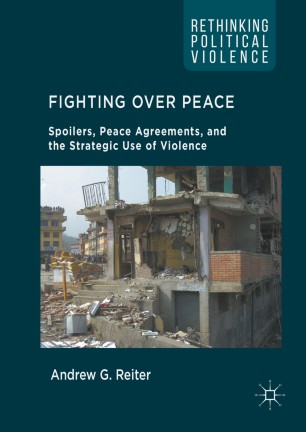
Fighting Over Peace: Spoilers, Peace Agreements, and the Strategic Use of Violence
-
 Writen byAndrew G. Reiter
 - PublisherPalgrave Macmillan
- Year2016
Fighting Over Peace explores the phenomenon of post-peace agreement violence, focusing on the role of "spoilers"—violent actors who undermine or derail peace processes after civil wars. The book argues that such violence is not only a predictable political phenomenon but can also be managed if understood within the right framework. By using both quantitative and qualitative analysis of a global dataset on spoiling, Reiter highlights the conditions under which spoilers become a significant threat to peace. He also demonstrates that spoiling often exposes flaws in peace agreements and implementation failures. This work challenges the perception that spoilers are always an unpredictable source of instability, suggesting that their behavior can be anticipated and mitigated through proper intervention strategies.Fighting Over Peace explores the phenomenon of post-peace agreement violence, focusing on the role of "spoilers"—violent actors who undermine or derail peace processes after civil wars. The book argues that such violence is not only a predictable political phenomenon but can also be managed if understood within the right framework. By using both quantitative and qualitative analysis of a global dataset on spoiling, Reiter highlights the conditions under which spoilers become a significant threat to peace. He also demonstrates that spoiling often exposes flaws in peace agreements and implementation failures. This work challenges the perception that spoilers are always an unpredictable source of instability, suggesting that their behavior can be anticipated and mitigated through proper intervention strategies.Fighting Over Peace explores the phenomenon of post-peace agreement violence, focusing on the role of "spoilers"—violent actors who undermine or derail peace processes after civil wars. The book argues that such violence is not only a predictable political phenomenon but can also be managed if understood within the right framework. By using both quantitative and qualitative analysis of a global dataset on spoiling, Reiter highlights the conditions under which spoilers become a significant threat to peace. He also demonstrates that spoiling often exposes flaws in peace agreements and implementation failures. This work challenges the perception that spoilers are always an unpredictable source of instability, suggesting that their behavior can be anticipated and mitigated through proper intervention strategies.Fighting Over Peace explores the phenomenon of post-peace agreement violence, focusing on the role of "spoilers"—violent actors who undermine or derail peace processes after civil wars. The book argues that such violence is not only a predictable political phenomenon but can also be managed if understood within the right framework. By using both quantitative and qualitative analysis of a global dataset on spoiling, Reiter highlights the conditions under which spoilers become a significant threat to peace. He also demonstrates that spoiling often exposes flaws in peace agreements and implementation failures. This work challenges the perception that spoilers are always an unpredictable source of instability, suggesting that their behavior can be anticipated and mitigated through proper intervention strategies.The book’s exploration of spoilers and their impact on peace agreements provides important insights for policymakers and peacebuilders in regions emerging from civil war or conflict. As peace agreements often fail or face significant challenges in implementation, the study of spoilers becomes vital for preventing the resurgence of violence and promoting long-term stability. These insights are highly applicable to current global challenges, including conflicts in Syria, Yemen, and other fragile states. Reiter’s work is valuable for community engagement efforts as it offers an understanding of the factors that can derail post-conflict peace processes. By identifying spoilers and their tactics, community leaders, NGOs, and international actors can better tailor their interventions to support the stability of peace agreements and create environments conducive to rebuilding trust and cooperation among formerly opposing groups. The book also offers lessons on the importance of addressing underlying issues that may lead to spoilers, which is essential for the rehabilitation of communities affected by conflict.