
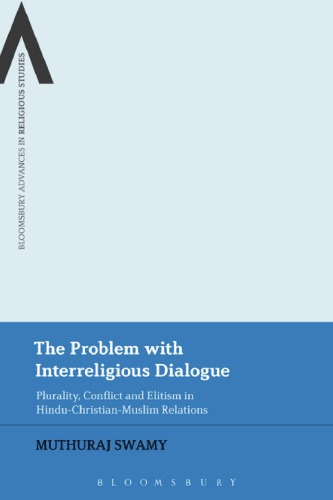
The Problem with Interreligious Dialogue:
-
 Writen by Muthuraj Swamy, Craig Martin (Editor), James Cox (Editor), Steven J. Sutcliffe (Editor)
 - PublisherBloomsbury Academic
- Year2016
This book critiques the world religions paradigm and the notion of interreligious dialogue by challenging the assumption that religions operate as separate entities from the lived experiences of their practitioners. It argues that dialogue, as presented by religious leaders and theologians, is often elitist and reinforces false separations between religions. Case studies from southern India illustrate how communities interact in ways that break the neat categories typically used to describe religions. Q The Problem with Interreligious Dialogue: Plurality, Conflict, and Elitism in Hindu-Christian-Muslim Relations" by Muthuraj Swamy critically examines the assumptions underlying interreligious dialogue, particularly the notion of distinct, essentialized religious identities. Swamy argues that such dialogues often overlook the lived experiences of practitioners and may inadvertently reinforce the very divisions they aim to bridge. Review:The book has been well-received for its innovative approach to interreligious studies. Anantanand Rambachan, in his review for the Journal of Hindu-Christian Studies, commends Swamy for challenging the homogenization of faith traditions and for emphasizing the importance of grassroots perspectives in understanding religious interactions. Rambachan notes that Swamy's work "encourages academics and social scientists to undertake similar research in other areas of religious studies," highlighting its broader applicability. Similarly, a review in Reading Religion praises Swamy's critique of the elitist nature of interreligious dialogue and his call for a "bottom-up," subaltern approach to understanding religious issues. The reviewer notes that Swamy "has successfully shown that most conflicts termed 'religious' are anything but that," underscoring the book's contribution to deconstructing misconceptions about religious conflicts. Relevance to Current Era: In today's globalized world, where interreligious interactions are increasingly common, Swamy's analysis remains pertinent. His critique of essentialized religious identities and the elitist nature of traditional dialogue models offers a timely perspective for fostering more inclusive and effective interreligious engagements.