
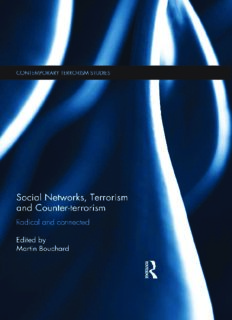
Social Networks, Terrorism and Counter-terrorism:
-
 Writen byMartin Bouchard
 - PublisherRoutledge
- Year2015
In Social Networks, Terrorism and Counter-terrorism: Radical and Connected, Martin Bouchard explores the role of social networks in radicalization and terrorism, examining how terrorists use social networks to recruit, communicate, and mobilize. The book analyzes the relationship between social media, terrorism, and the counterterrorism responses, offering insights into how these networks function and how they can be disrupted or leveraged in counterterrorism strategies. The book provides a theoretical framework and practical perspectives on the challenges and opportunities posed by social networks in the context of radicalization and violence. This book examines two key themes in terrorism studies, the radicalization process and counter-terrorism policies, through the lens of social networks. The book aims to show that networks should be at the forefront not only when analysing terrorists, but also when assessing the responses to their actions. The volume makes a unique contribution by addressing two relatively new themes for terrorism studies. First it puts social relations and cooperation issues at the forefront – an approach often identified as crucial to future breakthroughs in the field. Second, many contributions tackle the role of the Internet in the process of radicalization and in recruitment more generally, a highly debated topic in the field today. In addition, the book provides a valuable mix of review essays, critical essays, and original empirical studies. This balanced approach is also found in the topics covered by the authors, as well as their academic disciplines, which include sociology, computer science, geography, history, engineering, and criminology as well as political science. Many of the true advances in terrorism studies depend on the successful collaboration of multi-disciplinary teams, each with a different set of methodological and conceptual tools. This volume reflects the newfound diversity in this field and is a true product of its time. This book will be of much interest to students of terrorism studies, social networks, security studies, sociology, criminology and international relations in general. Current Era Relevance This book is highly relevant in the current era as social networks have become central to the dynamics of terrorism and counterterrorism. With the rise of platforms like Twitter, Facebook, and Telegram, terrorists can spread their ideology, recruit members, and plan activities more efficiently than ever before. The book discusses these issues, offering an in-depth understanding of how terrorists exploit the digital landscape, as well as how counterterrorism agencies can adapt and counteract these tactics. Its contemporary focus makes it crucial for anyone working on modern counterterrorism strategies or studying radicalization and the impact of social media. Educational Value: It provides significant value for policymakers, academics, and practitioners involved in counterterrorism, particularly those exploring digital countermeasures and the impact of online radicalization.